
Edward Snell
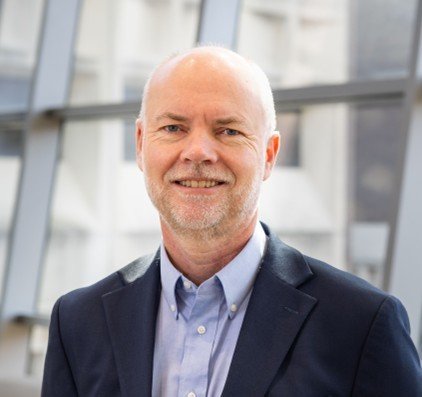
Dr. Edward Snell grew up just outside of Liverpool, UK. He attended the University of Liverpool, studying a new degree program called Physics for New Technology. After his first year, he began working for the Ministry of Defense at the Royal Armament Research and Development Establishment at Fort Halstead, south of London. During this period, he got to know London as a second home, and was present at the East German border when it opened in 1989, marking a significant historical moment.
Dr. Snell completed a B.Sc. in Applied Physics from John Moores University of Liverpool in 1992, earning a first-class honors, one of the highest distinctions in his class. He then moved to the University of Manchester Chemistry School as a graduate student under Professor John Helliwell, studying synchrotron crystallography. During this time, he participated in the second HERCULES school in Grenoble and Paris, a seven-week course offering lectures from experts in X-ray and neutron science in the mornings and practical sessions in the afternoons at various X-ray and neutron sources. Dr. Snell conducted research at synchrotron sources worldwide, particularly the Daresbury Synchrotron Radiation Source, the European Synchrotron Radiation Facility, and the National Synchrotron Radiation Light Source, with Daresbury becoming his default laboratory source due to its proximity.
During his graduate studies, Dr. Snell collaborated with the European Space Agency to study crystal growth and quality in microgravity, the reduced acceleration achieved by freefall in orbiting spacecraft. He was the first to observe Marangoni convection during crystallization on the European free flying Satellite EURECA. This demonstrated the unexpected impact of this process, masked on the ground, on crystallization experiments in space.
His studies with the European Space Agency on the EURECA free-flying satellite and the Space Shuttle Orbiter led to presentations and an annual crystallization meeting in Panama City Beach, Florida. This connection brought Dr. Snell into contact with scientists at NASA Marshall Space Flight Center (MSFC). He travelled up to Huntsville Alabama and visited MSFC to explore possibilities at NASA's Biophysical Laboratory. After earning his Ph.D. in 1996, Dr. Snell emigrated to the USA, joining MSFC as a National Research Council (NRC) Fellow. This prestigious postdoctoral research award is offered to promising scientists and provides high-quality self directed research opportunities at federal laboratories. Initially, Dr. Snell worked with Dr. Dan Carter, performing the first simulations of X-ray diffraction from polycapillary X-ray optics, and using the unique conections offered through NASA to study the cause and impact of transient accelerations on crystal growth on the Space Shuttle Orbiter. When Dr. Carter left to start his own company, Dr. Snell continued his research with Dr. Marc Pusey and his crystallization laboratory. His fellowship was extended to the maximum length due to his research and publication history.
Upon completing the NRC fellowship, Dr. Snell was employed by the Universities Space Research Association and later BAE Systems as a project scientist at NASA. He maintained his own research, served as a liaison for extramural researchers funded by NASA, and contributed to developing strategy for NASA biophysics research programs. He flew experiments on the Space Shuttle, the MiR Space Station, the International Space Station, and SpaceX rockets. For his efforts promoting collaborative research, Dr. Snell received the NASA MSFC Director's Commendation.
In 2005, Dr. Snell was offered a research scientist position at the Hauptman-Woodward Medical Research Institute. The Institute, under Dr. George DeTitta and Joseph Luft, had developed one of the first high-throughput crystallization laboratories in the world, offering incredible research opportunities. Dr. Snell contributed to a successful proposal that enabled this laboratory to become part of the Protein Structure Initiative. He secured funding from NIH, DOE, DoD, NASA, and private foundations to continue his research.
Dr. Snell played a key role in developing a $25M NSF proposal to advance the biological applications of X-ray Free Electron Lasers, led by Dr. Eaton Lattman and Science Director Dr. John Spence. The proposal succeeded, and Dr. Snell took over as director for its renewal in 2018, a combined $47.5M effort projected to produce approximately 1,000 publications and 2,000 structural models. He strategically renamed the high-throughput crystallization laboratory to the high-throughput crystallization center to reflect its impact. In 2021, under the new center director Dr. Sarah Bowman, the center became the National Crystallization Center and an NIH Research Resource.
He served as an assistant professor in the SUNY at Buffalo Department of Structural Biology from 2005 until its incorporation in the new downtown Jacobs School of Medicine and Biomedical Science in 2017 when he joined the Department of Materials Design and Innovation as the Bio-innovations chaired professor. Dr. Snell is also an adjunct professor in the Roswell Park Comprehensive Cancer Center's Cell Stress and Biophysical Oncology Department.
Dr. Snell became President and Chief Executive Officer of the Hauptman-Woodward Medical Research Institute in 2014, serving for nearly ten years before stepping down to become Chief Scientific Officer in 2023. Throughout his role in this position, he was recognized annually as one of the top 250 most influential voices in Western New York since 2015. He has served on numerous committees and national and international review panels, given numerous invited talks, workshops, and organized many meetings. In 2022 he was named a Fellow of the American Crystallographic Association, recognizing a high level of excellence in scientific research, teaching, and professional duties,
Dr. Snell enjoys traveling and experiencing new places and makes every opportunity to explore new places where he works or gives presentation. He holds dan grades in multiple martial arts, likes horseback riding when possible, and enjoys swimming and hiking. He is an avid reader and a good evening for him involves curling up with a good book and a cocktail or a nice glass of wine. A better evening is talking science with good company, good food, and the same cocktail or glass of wine.
Dr. Edward Snell was appointed Chair of the Department of Materials Design and Innovation at the University at Buffalo in 2026. The department focuses on the development of data-driven approaches to materials science, integrating computation, experiment, and design. In this role, he oversees research and educational programs spanning materials informatics, structural science, and interdisciplinary applications. The appointment follows his leadership at the Hauptman-Woodward Medical Research Institute and his involvement in large-scale collaborative programs, including the BioXFEL Science and Technology Center.
What did you want to be when you were younger? | I wanted to be a rocket scientist – and in many ways came pretty close. |
What primary school did you attend? | Our Lady’s School, Lydiate |
What did you study in school?
| Mostly science subjects, with a focus on understanding how the world works. |
What was your favourite subjects, please state your reason for this? | Biology and physics. At the time, I didn’t realize how deeply connected they are, but my career has ultimately been built on that intersection, using physics to understand biological systems. |
What did you enjoy most about Maricourt Catholic High School? | The sense of community and the influence of some truly excellent teachers who helped shape my direction. |
What did you study in Sixth form? | Physics, biology, chemistry |
What have you been doing since leaving school? | After completing my PhD, I spent about a decade working at NASA’s Marshall Space Flight Center in Huntsville, Alabama. During that time, I helped develop and fly experiments on the ESA EURECA satellite, the Space Shuttle, the Russian space station Mir, and the International Space Station.
I later moved to the Hauptman-Woodward Medical Research Institute in Buffalo, New York, where I worked for over a decade, ultimately serving as Chief Executive Officer.
I am now a Professor and Chair of the Department of Materials Design and Innovation at the University at Buffalo, part of the State University of New York system.
|
What advice would you give to our students to inspire them? | Talk to people, don’t be shy, take opportunities when they appear. Don’t be afraid to try something new, and don’t be the person who limits your own potential. |
What is a typical day in work for you in your career? | There really isn’t a “typical” day—that’s one of the most exciting parts of the job. Every day brings new challenges, new ideas, and new opportunities. |
What is the most rewarding part of your job, please state your reasons for this? | Scientifically, solving a new protein structure is incredibly rewarding—you are often the first person in the world to see something that has never been observed before.
From a leadership perspective, helping others succeed—students, researchers, and colleagues—is just as fulfilling. |
My message to young people deciding on a future career is? | You can achieve your ambitions but focus on taking one step at a time. Progress builds success. |